
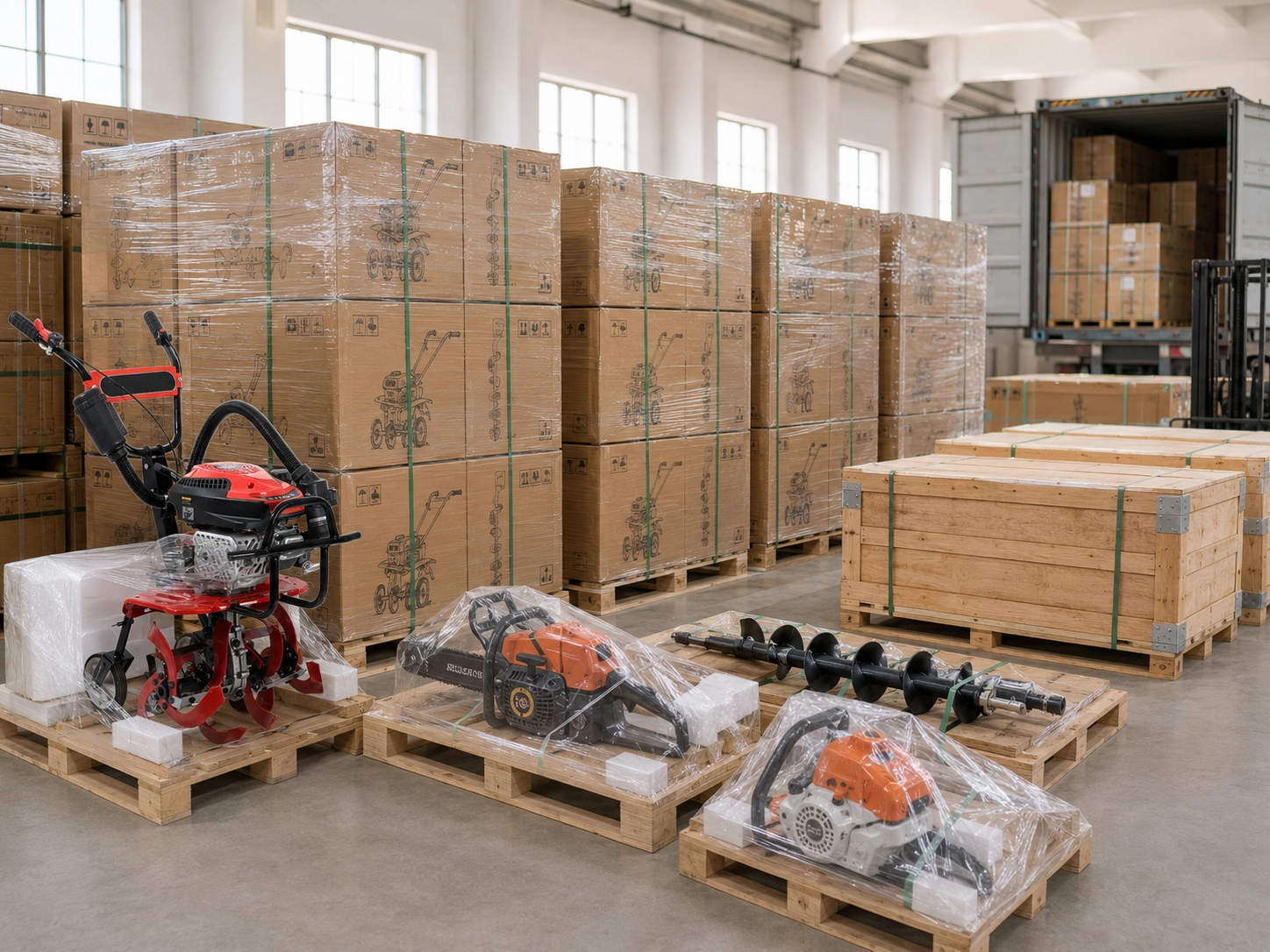
Chainsaws and Earth Augers: Selecting the Second Machine for a Smallholding Toolkit
Quick answer: A tiller prepares soil, but it does not fell a tree, cut firewood or dig a fence post hole. Chainsaws and earth augers cover those jobs, and both are selected by the same logic that governs tiller choice: the engine size must match the task's sustained load, and the working geometry must fit the space the machine will be used in. A chainsaw is sized by bar length and engine displacement working together; an earth auger is sized by bit diameter and the torque needed to turn it against soil resistance. Choosing either one by engine size alone produces the same failure seen in tillers — a machine that is either too heavy to use comfortably or too weak to finish the job.
Smallholders and landscape contractors rarely buy one machine. They assemble a set: something to prepare ground, something to cut wood, something to make holes. The equipment categories are usually sourced together because they share the same engine technology, the same fuel handling and, often, the same service network. Getting the second and third machines right matters as much as getting the first one right, and the selection criteria are less familiar to buyers because tillers dominate the available guidance.
Chainsaws: bar length and displacement are two separate limits
Buyers commonly treat bar length as the machine's size rating. It is not. Bar length and engine displacement constrain different things, and they must be selected against each other.
| Selection factor | What it limits | What happens when it is wrong |
|---|---|---|
| Bar length | The maximum trunk diameter the saw can cut in a single pass from both sides | Too short — the operator cuts from more angles, increasing kickback exposure and producing an uneven scarf |
| Engine displacement | The torque available to pull the chain through the cut under load | Too small for the bar — the chain stalls mid-cut, the operator forces the saw, and the engine overheats |
| Chain pitch and gauge | How efficiently engine torque converts into cutting speed | Mismatched chain and sprocket accelerate wear on both and reduce effective power at the bar |
| Weight and balance | How long the operator can work before fatigue degrades control | The saw is capable of the job but the operator's arms are not — and fatigue is a leading cause of chainsaw injury |
| Anti-vibration system | Hand-arm vibration exposure over a working day | Extended use produces numbness and loss of grip, which compounds every other safety risk |
The pairing rule is that displacement must grow with bar length, and it must grow faster than the bar does. A long bar on a small engine is the single most common misconfiguration in this category: the saw appears ready for large timber, then cannot complete the cut it was bought for.
Bar length is a task measurement, not a capacity claim
Bar length tells you the largest diameter the saw can address in one setup. It does not tell you what the saw should be used on routinely. A saw asked to cut at its maximum diameter on every tree is being run at its limit continuously, and both the power unit and the operator pay for it. The practical approach is to select a bar that comfortably exceeds the diameter of the bulk of the work, so that the majority of cuts run well inside the machine's capacity and only occasional trunks approach the limit.
What the second-hand market reveals about sizing
A useful signal when sizing a saw is the used-equipment market. Saws that are consistently resold with low hours are usually over-sized for their original buyer's actual work — the machine was bought for a capability that turned out to be rarely needed, and its weight made it unpleasant to use for the routine jobs that dominated. Saws that are resold worn out are usually correctly sized. Weight is the specification buyers under-weight, and it is the one that determines whether the machine gets used.
Earth augers: bit diameter drives everything else
An earth auger's performance is governed by the diameter of the bit it turns, because bit diameter determines the volume of soil displaced per rotation and therefore the torque required.
| Application | Bit diameter range | What the job demands |
|---|---|---|
| Fence posts, vine stakes, small plantings | Narrow | Moderate torque, high portability — the operator moves between many holes |
| Orchard and landscape tree planting | Medium | Sustained torque in undisturbed soil, often on sloped ground |
| Deep root-ball and structural planting | Wide | High torque and enough mass to resist the reaction force without the operator absorbing it |
Two-stroke earth augers follow the same fuel-handling discipline as two-stroke tillers: pre-mixed fuel at a fixed ratio, and a mixing error is the most common cause of engine damage. The fuel mix ratio and tank capacity are specifications worth reading before purchase, because they determine how many holes can be drilled between refuelling stops — and refuelling in the middle of a planting run is a workflow cost, not just an inconvenience.
The reaction force problem
An auger bites into the ground and the ground pushes back. If the auger's bit catches on a root or a stone, the reaction arrives suddenly. The machine's mass and the handlebar layout determine whether the operator can absorb that without losing control. This is why an auger that is powerful enough for a wide bit can still be the wrong machine for one operator: above a certain diameter, the reaction force exceeds what one person can hold against.
The practical configuration decision is whether the machine will be hand-held or guided by a frame. Hand-held units suit narrower bits and lighter soils; framed and wheeled units allow wider bits because the frame absorbs the reaction instead of the operator. Choosing the bit first and then discovering that the machine needs a frame is a familiar and avoidable sequencing error.
Power source across the toolkit
The power-source question that applies to tillers applies to these machines as well, but the trade-off lands differently.
| Consideration | Two-stroke gasoline | Electric / battery |
|---|---|---|
| Power-to-weight | High — the decisive advantage for hand-held tools | Lower, and the battery adds mass that does not reduce with use |
| Runtime | Limited only by fuel carried | Limited by battery capacity and recharge time |
| Where it wins | Remote sites, extended sessions, heavy timber and hard soil | Enclosed or residential areas, intermittent work, noise-sensitive settings |
| Maintenance profile | Fuel mixing discipline, carburettor and filter care | Battery cycling life, motor and switchgear |
| Refuelling / recharging workflow | Refuel on site in minutes | Return to a power source, or carry spare packs |
For chainsaws and hand-held augers, the power-to-weight advantage of two-stroke is decisive in professional and semi-professional use, because the operator carries the machine. Where the work is close to a power source and intermittent — a garden, a small holding near a building — the electric option removes the fuel-mixing discipline that causes most two-stroke engine failures. The choice follows the work pattern, not the machine category.
Service commonality across a mixed toolkit
Buying several machines from one supplier is usually justified by price, but its larger benefit is service commonality. Machines that share fuel mixing ratios, filter types, spark plug specifications and starting mechanisms reduce the number of distinct spare parts a distributor or a farm workshop must hold, and reduce the number of procedures an operator must learn correctly.
The specification to check is not whether the machines look similar. It is whether the consumable and high-wear parts are shared. A toolkit where every machine uses the same pre-mix ratio and the same filter family is materially cheaper to keep running than one assembled from unrelated models, even if the purchase prices are identical.
This is also the practical reason to ask about spare parts availability before purchase rather than after. For any machine in this class, the parts that determine working life — blades and bits, filters, starter assemblies, fuel lines, chains and sprockets — should be confirmed as available for the destination market, with a stated lead time.
Selection checklist for the second machine
- Name the dominant task in measurable terms. Trunk diameter for a saw, hole diameter and depth for an auger, and how many of each per season.
- Size the engine against the working geometry — displacement against bar length, torque against bit diameter — not against engine size alone.
- Weigh the machine against the session length. The tool that gets used is the one that can be carried for the duration of the job.
- Decide hand-held or framed before choosing the bit or bar size, because the frame determines what reaction force is manageable.
- Match the power source to the work pattern and the proximity of a power supply, not to a general preference.
- Check parts commonality across the whole toolkit, and confirm spare availability with lead times for your market.
- Confirm the safety provisions appropriate to the tool — chain brake and anti-vibration on a saw, and a clear reaction-force plan for the auger.
Should the bar length match the largest tree I expect to cut?
No. Size the bar to comfortably exceed the diameter of most of your work, so routine cuts run well inside the machine's capacity. Buying for the occasional largest trunk means carrying extra weight and engine size on every routine job, which is why over-sized saws are the ones most often resold with low hours.
What fuel ratio do two-stroke augers and chainsaws use?
Ratios are model-specific and stated by the manufacturer — commonly in the region of 25:1 to 50:1 for equipment in this class. The ratio is not a preference: running the wrong mix is the most common cause of seizure in two-stroke engines. Always confirm the ratio for the specific model and use a measuring container rather than estimating.
Can one auger handle both fence posts and tree planting?
Usually yes, if the bit set spans both diameters and the power unit has the torque for the larger bit. The constraint is the reaction force: a bit large enough for tree planting may exceed what a hand-held unit can hold against in firm soil, which is the point at which a framed or wheeled configuration becomes necessary.
Is a battery chainsaw suitable for professional work?
It depends on the duty cycle. Battery saws suit intermittent work near a power source and are excellent in noise-sensitive or enclosed settings. For extended sessions, heavy timber or remote sites, the runtime and recharging workflow become the limiting factor, and gasoline remains the practical choice. The decisive question is how long the machine must run between access to power.
What should I confirm about spare parts before ordering a mixed toolkit?
Confirm three things for every machine: which high-wear parts are shared across the range, what the lead time is for those parts into your market, and whether they can be consolidated into a single spare parts order. A toolkit that shares consumables costs materially less to keep running than one where every machine needs its own parts stock.
Building a complete smallholding toolkit? Tell us the work you need to cover — land preparation, timber cutting, post and planting holes — and the conditions in your market, including terrain and soil. We will recommend a set of machines that is sized for the actual tasks and shares consumables and spare parts, rather than three unrelated units that each need their own parts stock.